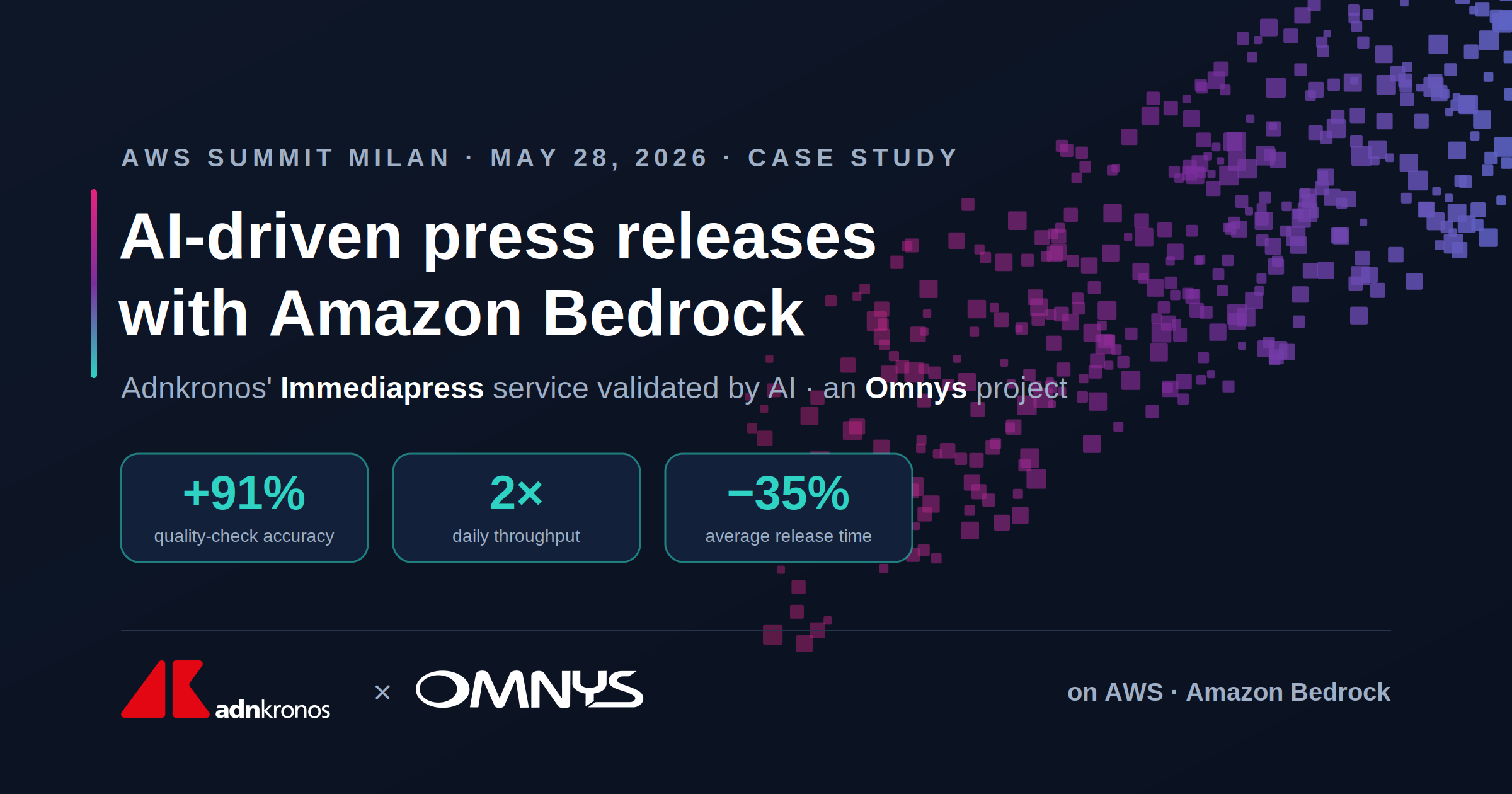
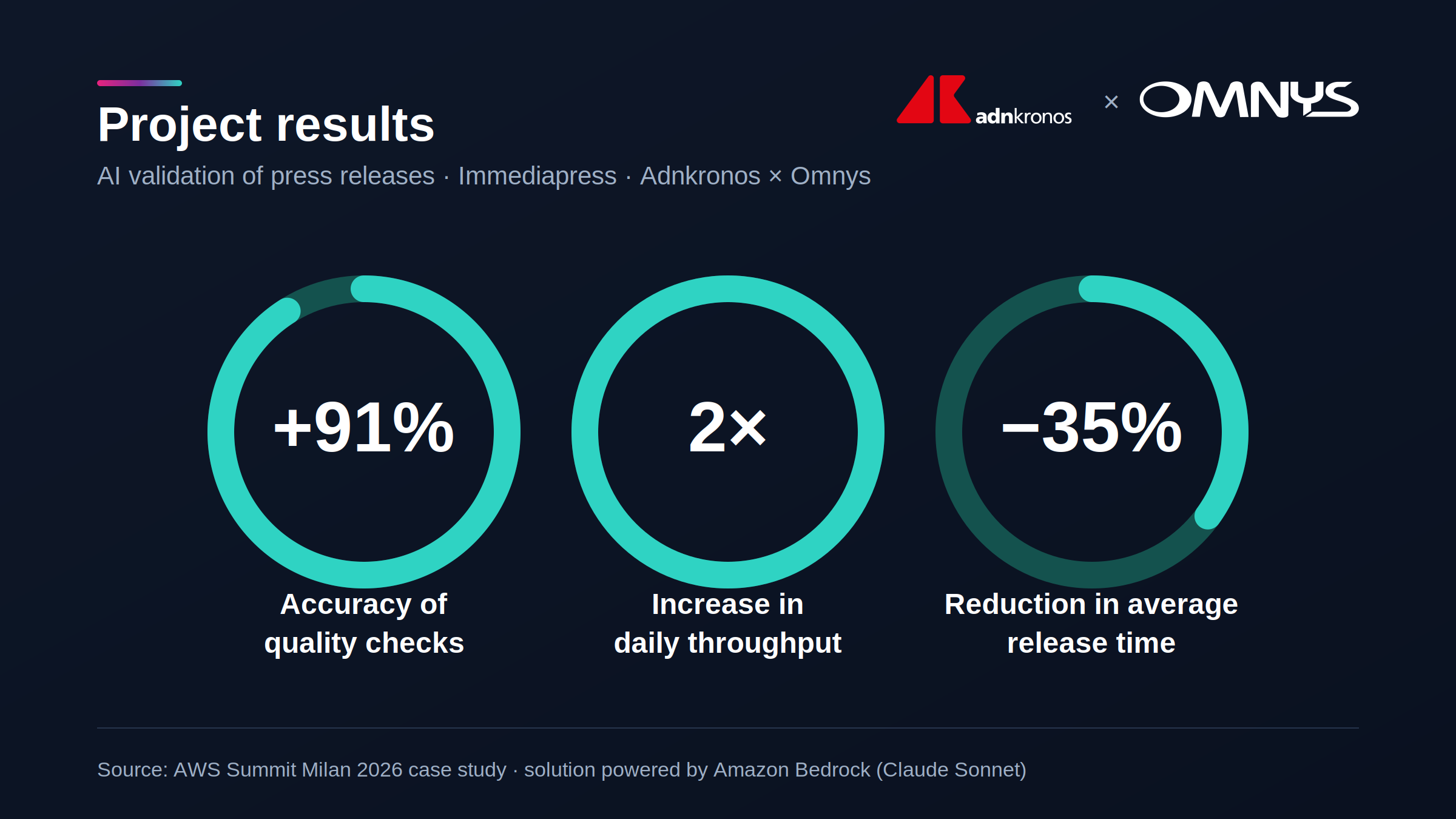
 At AWS Summit Milan 2026, Omnys and Adnkronos presented a project in a breakout session that brings generative artificial intelligence into the heart of the editorial process of one of Italy's leading press agencies. The project is a press release pre-validation system that improves the accuracy of quality checks by 91%, doubles daily throughput, and cuts the average release time by 35%.
On 28 May 2026, Omnys and Adnkronos took to the stage at AWS Summit Milan to share their real-world experience of applying generative AI to the news industry. The session, "Adnkronos: AI-driven press releases with Amazon Bedrock" (PRT202-S), featured Davide Pozza (Partner and CTO at Omnys), Adriano De Iuliis (IT Project Manager at Adnkronos Comunicazione) and Federico Agostini (Senior AI Engineer at Omnys). The common theme was editorial quality, as captured by the Gabriel García Márquez quote that opened the talk: "In journalism, just one false fact prejudices the entire work."
Founded in 1963, Adnkronos is an Italian press agency that serves as a reference point for institutions, media outlets and businesses. It offers an integrated communication service for public and private partners across multiple channels. Through its controlled press release distribution service, Immediapress, every piece of content is thoroughly analysed in compliance with strict ethical and self-regulatory constraints.
However, this quality oversight must contend with high volumes: a large number of releases require careful reading and analysis every day. This is an activity that relies on specific editorial expertise, which is concentrated in senior reviewers and is therefore difficult to scale up. Ambiguous cases further complicate matters: a release can be formally correct yet still violate policy because context and a real risk assessment are required. The project therefore started with the question of how to preserve editorial standards while increasing capacity.
Omnys has designed a pre-validation system that supports reviewers without replacing them and integrates into the existing editorial workflow. The six-step process involves content extraction, retrieval of relevant examples from the archive, prompt construction, processing by the language model, generation of a structured output, reviewer feedback, and finally publication. The reasoning engine is the Claude Sonnet model, which is used through Amazon Bedrock to analyse each release against company guidelines and produce a result that complies with a defined schema.
The structured output is what adds the most value. For each release, the system provides an editorial traffic light, a risk assessment based on 25 criteria derived from the company guidelines, and textual evidence in the form of verbatim quotations from the text, alongside a description of the issue, its severity level, recommended actions and the rationale for any block, as well as mitigation suggestions for the reviewer. This means that every release reaches the reviewer already pre-classified with issues highlighted and contextualised.
One distinctive feature of the architecture is the custom retriever. A standard retrieval model relies solely on semantic text similarity and fails to capture assessments derived from guidelines and reviewers. This is why Omnys developed a proprietary retriever based on a multilingual MiniLM model that was optimised through fine-tuning on information retrieval tasks using SetFit and cosine similarity loss. By collecting reviewers' rationales and feedback over time, the system can be retrained to adhere ever more closely to the editorial guidelines, making this valuable context available to the model.
The entire solution runs on an AWS cloud architecture that is designed to be secure and scalable. Access from the CMS and reviewers goes through an Application Load Balancer that is protected by WAF and ACM certificates. Processing takes place on an ECS cluster with backend services in private subnets. Amazon Bedrock provides inference, while Aurora MySQL, OpenSearch, and Amazon S3 handle data indexing and storage.
The project's impact is measurable.
The journey does not stop here. Our next goals include content classification with AI-driven tagging, a relevance index for scoring topic-based content to support distribution priority, and dynamic aggregation — an agent that explores distributed content starting from a specific prompt and generates dynamic, controlled aggregations.
The Immediapress project exemplifies Omnys' approach to artificial intelligence, offering enterprise solutions built on AWS that combine generative models, proprietary components, and an in-depth understanding of clients' domains to deliver tangible value across business processes while maintaining human oversight of quality.
