
Discover how Omnys automated drug testing with AI, improving accuracy, digital reporting, and data security for occupational health.
In the diagnostics industry, speed and accuracy are non-negotiable requirements. In this context, Omnys developed a solution for a company operating in the sector that integrates visual AI into the diagnostic process to simplify test reading, report generation, and result accuracy.
The collaboration with the drug test device manufacturer gave rise to an innovative artificial intelligence solution. Omnys transformed a diagnostic process traditionally subject to interpretive variability into an automated, precise, and scalable system — demonstrating how AI can deliver tangible improvements in operational efficiency within the healthcare sector.
AI in Diagnostics: Standardization and Decision Support
In the field of diagnostics, visual artificial intelligence and computer vision technologies have demonstrated levels of accuracy comparable to clinical standards. In specific application areas — particularly when integrated into structured workflows supervised by healthcare professionals — they have proven to be reliable partners in final report generation.
A key advantage is processing speed: AI systems complete complex analyses in just seconds, helping to boost the operational efficiency of medical staff. Applied in this scenario, AI supports healthcare operators in making faster and more accurate decisions.
The Challenge: Eliminating Variability in Test Interpretation
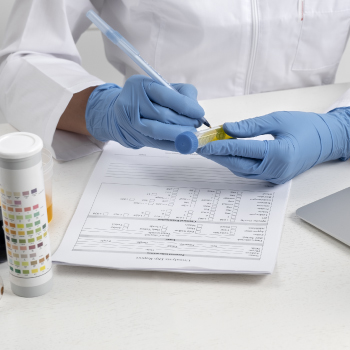
The company, which specializes in manufacturing drug test devices, faced a critical challenge. Their point-of-care tests for detecting opiates, alcohol, cocaine, and other substances are an essential tool used across multiple settings — from occupational health to roadside checks, from hospital screenings to forensic investigations.
The devices used — blister packs containing chemical reagents — deliver results through colored lines indicating different levels of positivity for each substance. While this system is well-established and chemically reliable, the result interpretation phase was susceptible to inconsistencies.
The Omnys Solution: Visual AI, Mobile, and Cloud for an End-to-End Process
Omnys designed and developed an end-to-end solution powered by artificial intelligence. The system combines image capture via a mobile app with cloud-based AI processing through to automatic report generation.
- Mobile App and Image Capture. An intuitive mobile application allows operators to photograph the drug test blister directly from their smartphone. Once captured, the image is automatically uploaded to the cloud for processing.
- Machine Learning Model. At the core of the solution is an AI model based on machine learning techniques, trained on thousands of annotated images. The model can automatically detect areas of interest on the blister, precisely analyze the intensity and coloration of reaction lines, classify each indicator according to validated clinical parameters, and handle variable lighting conditions.
- Automatic reference generation. Once the AI analysis is complete, the system automatically generates a PDF report containing: patient data, detailed results for each tested substance, analysis confidence levels, and space for customizable notes. The operator maintains full control over the final report, being able to review results and add comments before digitally signing. The system integrates seamlessly with management software via secure APIs, eliminating the need for manual entry and drastically reducing the risk of transcription errors.
Measurable Impact: Greater Precision, Efficiency, and Control
Adopting the AI solution has delivered tangible benefits in both clinical and operational terms. Digitizing the reading and reporting process has made it possible to standardize analysis, reduce error margins, and optimize the organization of screening activities.
- Greater Diagnostic Precision. The AI system significantly reduces interpretation errors. Thanks to its ability to analyze chromatic intensity and the morphological characteristics of reaction lines with extreme precision, the model maintains consistent diagnostic quality regardless of external factors such as operator fatigue or environmental conditions.
- Increased operational efficiency. Increased Operational Efficiency. Reduced reporting times have a direct impact on facility organization. The process of capture, analysis, and report generation is significantly faster and more efficient.
- Reduced Risk of Human Error. Manual transcription errors have been eliminated, and the ability to perform mass screenings enables significantly higher volumes to be processed while maintaining consistent quality. For organizations conducting large-scale screenings, this translates into significant cost savings and an improved experience for end users.
- Regulatory Compliance and Safety. Regulatory Compliance and Security. The system was designed in full compliance with European regulations on health data protection (GDPR) and medical device directives.
Conclusions: A Model for Innovation in Diagnostics
The Omnys success story demonstrates how artificial intelligence, when applied with technical expertise and an understanding of the clinical domain, can generate real value in the healthcare sector. The solution supports healthcare operators in their daily work, allowing them to focus on the more complex aspects of assessment while AI handles standardized image analysis.